


ALUMINIUM
Aluminium, or what was once metallic aluminium, was first obtained in 1886 by electrolysis, which was pioneered by the American Charles Martin Hall and the Frenchman Paul Héroult. However, the technological process of aluminium, which we still use today, begins with the extraction of aluminium oxide from bauxite ores, which in turn was developed by Austrian chemist Karl Bayer in 1887. It is interesting to note that it takes 2 kg of aluminium oxide to produce 1 kg of aluminium, which is produced from 4 kg of bauxite.
By enriching the alloy with elements such as silicon, magnesium, manganese, copper or zinc, for example, this lightweight material is given versatile properties. It is a material commonly used in the automotive, electronics, construction, shipbuilding, military and aerospace industries.
Importantly, aluminium has unlimited recyclability and the reprocessing of aluminium does not result in a decrease in performance or quality. In addition, it is accepted that recycling requires only a few per cent of the energy associated with the entire process.
TABLE OF CONTENTS
General designations of the states of consolidation of aluminium
| Designation | Importance of |
| F | raw state - used for products from the shaping process which do not require any specific heat treatment or strengthening by crushing |
| O/H111 | annealed - applied to products that have been heated to obtain a structure close to equilibrium, improve ductility and dimensional stability |
| H | Crush strengthened - applied to products strengthened by cold processing. Can be used as an additional stage in heat treatment |
| W | supersaturated - unstable state, used only for alloys that spontaneously age at room temperature after heat treatment |
| T | heat-treated to obtain stable states other than F, O and H. Applied to products that have been heat-treated, often with complementary crushing to obtain equilibrium states |
Aluminium grades
1000 series
1050A
Al 99.5
A1
1070A
Al 99.7
A0
1080A
Al 99.8 (A)
A00
1350A
EAl 99.5 (A)
-
2000 Series
2007
AlCu4PbMgMn
-
2011
AlCu6BiPb
-
2017A
AlCu4MgSi (A)
PA6
2024
AlCu4Mg1
PA7
3000 Series
3003
AlMn1Cu
-
3004
AlMn1Mg1
PA5
3005
AlMn1Mg0.5
-
3103
AlMn1
PA1
3105
AlMn0.5Mg0.5
PA16
5000 series
5005A
AlMg1 (C)
PA43
5083
AlMg4.5Mn0.7
PA13
5251
AlMg2
PA2
5754
AlMg3
PA11
6000 series
6060
AlMgSi
PA38
6061
AlMgSiCu
PA45
6063
AlMg0.7Si
-
6082
AlSiMgMn
PA4
7000 series
7020
AlZn4.5Mg1
PA47
7022
AlZn5Mg3Cu
-
7050
AlZn6CuMgZr
-
7075
AlZn5.5MgCu
PA9
7475
AlZn5.5MgCu
-
1000 series - refers to high-purity aluminium (above 99%).
Includes materials with high ductility and low strength. It is aluminium used mainly in transport, architecture and the food industry.
2000 Series - includes aluminium alloys with a few per cent copper content and the addition of manganese and magnesium.
These are high-strength materials with medium resistance to rust.
It is used primarily for the manufacture of machine parts.
3000 Series - concerns aluminium-manganese alloys.
This group includes materials with low strength and excellent corrosion resistance. These alloys are used in the chemical and food industries, as well as in the production of finishing and decorative elements.
4000 Series - refers to aluminium-silicon alloys.
These materials are distinguished by their excellent corrosion resistance and high strength. They are used in the manufacture of rims as well as tools.
5000 series - includes aluminium-magnesium alloys.
They are distinguished by their high rust resistance and medium strength.
They can be anodised and welded. These materials are used in the manufacture of domestic appliances, as well as in the chemical, construction and food industries.
6000 series - are alloys of aluminium with magnesium and silicon.
They are distinguished by their excellent corrosion resistance and ductility.
They are used in: furniture, lighting, construction, electronics, interior fittings, as well as in the mining, chemical, food and shipbuilding industries, as well as in load-bearing components for trucks, buses, ships, cranes, carriages, bridges and barriers.
7000 series - includes aluminium-zinc-magnesium alloys.
They gain a very high level of strength during heat treatment. They have medium corrosion resistance. These alloys can be machined and welded. They are used in machine components, sports equipment, as well as stressed structural parts and aircraft parts.
8000 series - applies to all other aluminium alloys. Both their properties and their machinability depend on their chemical composition.
Explanation of the states of consolidation of aluminium
| Designation | Importance of |
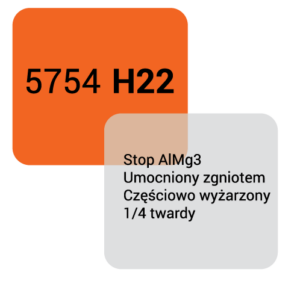
| H1X | Only crush strengthened |
| H2X | Strengthened and partially annealed |
| H3X | Strengthened and stabilised |
| H4X | Reinforced and painted/painted |
The first digit after the letter H indicates the treatment from which the parameter was derived
| Designation | Importance of |
| HX2 | 1/4 hard |
| HX4 | 2/4 hard |
| HX6 | 3/4 hard |
| HX8 | 4/4 hard |
| HX9 | Extra tough |
The first digit after the letter H indicates the treatment from which the parameter was derived
Heat treatment states of aluminium long products
| Designation | Importance of |
| T1 | naturally aged after cooling from the elevated temperature of the forming process |
| T2 | cold deformed after cooling from the elevated temperature of the forming process and naturally aged |
| T3 | supersaturated, cold deformed and naturally aged |
| T4 | over-saturated and naturally aged |
| T5 | artificially aged after cooling from the elevated temperature of the forming process |
| T6 | over-saturated and artificially aged |
| T7 | oversaturated and stabilised (obsolete) |
| T8 | supersaturated, cold deformed and artificially aged |
| T9 | supersaturated, artificially aged and cold deformed |
Source:
EN 515 "Aluminium and aluminium alloys"
The data contained in the above tables are indicative.
Perforated sheets
Perforated sheets are manufactured from the highest quality stainless steel, acid resistant, aluminium, brass and copper. They are characterised by durability, lightness and universality of application. They are used in the engineering, food, agricultural and construction industries and as decorative elements.
Holes are made in various shapes, including: circular, cylindrical, conical, conical-cylindrical, square, rectangular, hexagonal, bowl-shaped, elongated and others according to individual designs.
Due to their widespread decorative use, perforated sheets are often covered with protective and decorative coatings.
Rv
Round holes,
60° passing system
rg
Round holes,
straight 90° system

rd
Round holes,
45° diagonal arrangement

qg
Square holes,
straight 90° system
qv
Square holes,
60° passing system
qd
Square holes,
45° diagonal arrangement

lv
Longitudinal openings,
system passed

lg
Longitudinal openings,
simple system
hv
Hexagonal holes,
hexagonal,
60° passing system
deco
Holes
decorative


Brzezie, 92 Szlachecka St.
32-080 Zabierzów
NIP: 678-314-93-06
REGON: 122910963
Monday to Friday
7.30 a.m. to 3.30 p.m.
Monday to Friday
7 a.m. to 3 p.m.
 English
  Polish